History
In 1630, a wooden church dedicated to St. Dorothy was built in Leśnica as a filial of the parish in Lechnica. The main altar featured a wooden statue of St. Dorothy, which to this day remains in the side altar of the present Church of St. Michael.
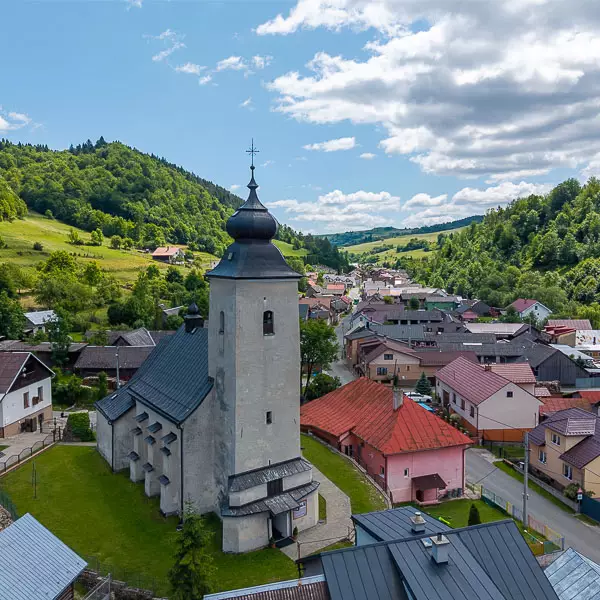
In 1757, a new masonry church dedicated to St. Michael the Archangel was erected in Leśnica. The parish was established in 1776. After a fire in 1792, external buttresses were added, the bell tower was raised, the arches were rebuilt, and the façade was renovated.
The faithful from Poland
According to oral tradition, the faithful from the Polish side, when coming to Sunday Mass, each brought a stone from the Pieniny Mountains for the construction of the new church. From that time also comes the legend of a pregnant woman from Niżna Szczawnica, who suddenly experienced severe labor pains, with both her life and that of her child in danger. Her relatives went to the church in Leśnica to pray before the statue of St. Dorothy. The mother and child survived, and since then the statue has been regarded as merciful.
17th-century architecture
The church has a compact, single-nave form with a narrower, polygonally closed presbytery. To the west rises a square tower topped with a distinctive onion-shaped dome, while a small ridge turret is visible on the roof’s crest.
The nave is covered with a gable roof, and the presbytery with a multi-pitched roof. The entire structure is clad in sheet metal. The façade is light-colored, with narrow, vertical, semicircular-arched windows. The church’s structure has been reinforced with buttresses. The main entrance is located at the base of the tower; above the portal is a cartouche bearing the date 1792.
Inside the tower hangs the bell of St. Urban from 1765, a gift from Emperor Joseph II, brought from the Red Monastery dissolved during the Josephine reforms. During World War I, Austrian authorities confiscated church bells to be melted down into cannons. In Leśnica, however, the original bell remained—likely out of respect for the emperor’s stature as its donor.
The people believe in the power of the Leśnica bells, said to be able to drive away storms. This power, they claim, lasts only as long as the bells are not rung against their enemy. This belief is also confirmed in Szczawnica: before a storm, locals listen for the sound of Leśnica’s bells and trust the storm will pass them by.
Baroque interior
The main altar of the Church of St. Michael in Leśnica is richly decorated in the late Baroque style. At its center is a painting of St. Michael the Archangel from the mid-18th century, flanked by statues of Saints Peter, Paul, Anne, and Joachim. The altar is crowned with a relief depicting the Holy Trinity.
The pulpit dates from the mid-18th century. Its lower section features carvings of the four Evangelists, while the canopy bears the symbol of the Holy Spirit in the form of a dove, topped with a figure of St. John the Baptist. The church also houses a valuable Renaissance stone baptismal font from the 16th century.
To the left of the main altar stands the altar of St. Dorothy. Its lower section is early Baroque in style, with a central statue of the saint. On either side are figures of St. George and St. Catherine of Alexandria. The upper section, added later, is adorned with angels and a statue of Bishop St. Adalbert (St. Wojciech). The entire altar is crowned with an image of the Risen Christ.
On the right side stands the Marian altar from the 17th century, created in the tradition of the so-called Black Madonnas. A special custom is its covering during October, the Month of the Rosary, with a painting of Our Lady of the Rosary. In other months, this painting is hung above the entrance to the sacristy. The altar is flanked by statues of St. Stephen, King of Hungary, and his son Emeric (Imrich).
Together, the furnishings of the Church of St. Michael the Archangel in Leśnica form a coherent Baroque interior.
Polychrome
In 1948, the interior of the church was decorated by Ladislav Berecz. A self-taught artist, he created sacred polychromies in Galanta, Poprad, Bratislava and Košice. He also painted Tatra landscapes, scenes from the lives of gypsies, symbolic and allegorical compositions, all in a post-impressionist style with rich colors. His works can be bought at Slovak art auctions.
Pilgrimages of friendship


-2025-07-11-06-46-49.webp)